By Bennett's Concrete and Excavation, Norwich, NY. Updated October 2026.
What frost heave is
Pavement Interactive, a pavement engineering reference, defines frost heave as an upward movement of the ground caused by soil moisture expanding as it freezes. It isn't just water in the soil turning to ice in place. As the ground freezes, water is drawn up toward the freezing zone and forms layers of ice called ice lenses. The lenses keep growing as long as water keeps coming, and they push up whatever is above them: a slab, a step, a footing or a fence post.
That's why heave can be far bigger than the small expansion of water turning to ice would suggest.
The three ingredients
Frost heave needs all three of these at once:
- Frost-susceptible soil with a significant amount of fine particles.
- Freezing temperatures that reach down into that soil.
- A water supply: groundwater, rain or snowmelt soaking in, or moisture held in fine soil.
Take away any one and heave drops or stops. Pavement Interactive also notes that slower freezing produces thicker ice lenses, which is one reason long cold snaps do more damage than quick ones.
Which soils heave
Fine soils are the problem. Silty soils are frost susceptible; clean sands and gravels are not. Pavement Interactive cites a common agency rule that treats soil as frost susceptible when 10 percent or more passes the 0.075 mm sieve, or 3 percent or more passes the 0.02 mm sieve.
Much of Central New York sits on clay, silt and glacial till that hold water and drain slowly. That's why a stone base under concrete matters so much here. See clay soil and concrete in Central NY.
How deep frost goes here
KHH, an engineering firm writing about Central New York, cites US military design tables for Syracuse: maximum frost penetration of 6 feet 1 inch, a design footing depth of 3 feet 6 inches for a heated building and 4 feet 8 inches for an unheated one. It notes most local engineers use 4 feet, and that a harsh winter with deep frost caused heave failures of decks, garages and other structures in the region.
A slab on the ground can't be 4 feet deep, so flatwork deals with frost a different way: by controlling the soil and the water under it.
Spring thaw: the second problem
Heave is only half of it. When the ice in the ground melts in spring, the water can't drain away quickly, and the soil loses much of its strength. Pavement Interactive calls this thaw weakening. Loads the ground carries easily in summer can cause damage during spring thaw. It's the same reason back roads post weight limits in mud season, and a reason to keep heavy trucks off a driveway's edges in March and April.
How builders keep concrete from heaving
- Footings below frost depth for anything attached to a building, as your code office requires.
- Insulation to keep frost away from shallow footings. The HUD and NAHB guide to frost-protected shallow foundations explains how heat from the building plus foam insulation raises the frost line near the foundation.
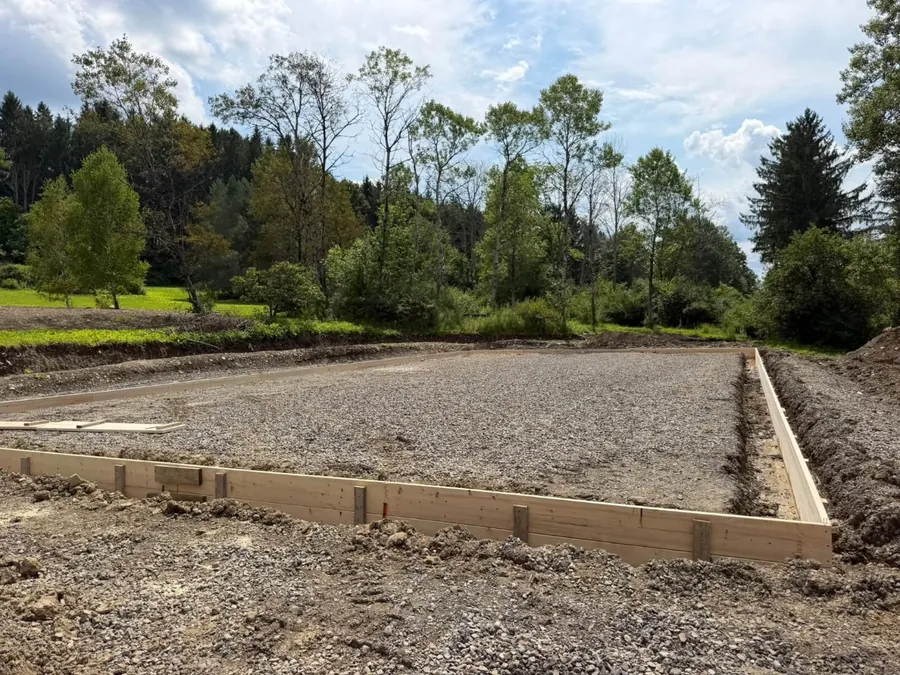
- A clean, compacted stone base under slabs, replacing frost-susceptible soil near the surface.
- Drainage: grading, downspouts and ditches that keep water from soaking in under the concrete.
- Isolation joints between slabs and the house, so a walk can move without lifting a door sill or step.
- Never pouring on frozen ground; see cold weather concrete.
What to do about a slab that heaves
A walk or patio that lifts in winter and settles back in spring is telling you there's water and fine soil under it. Sealing the cracks won't change that. The lasting fix is to remove the section, dig out the wet soil, put in a drained stone base and correct the grading. Bennett's does that work with our own equipment: site prep and grading, excavation and concrete removal and replacement. For foundations, read frost-protected shallow foundations.