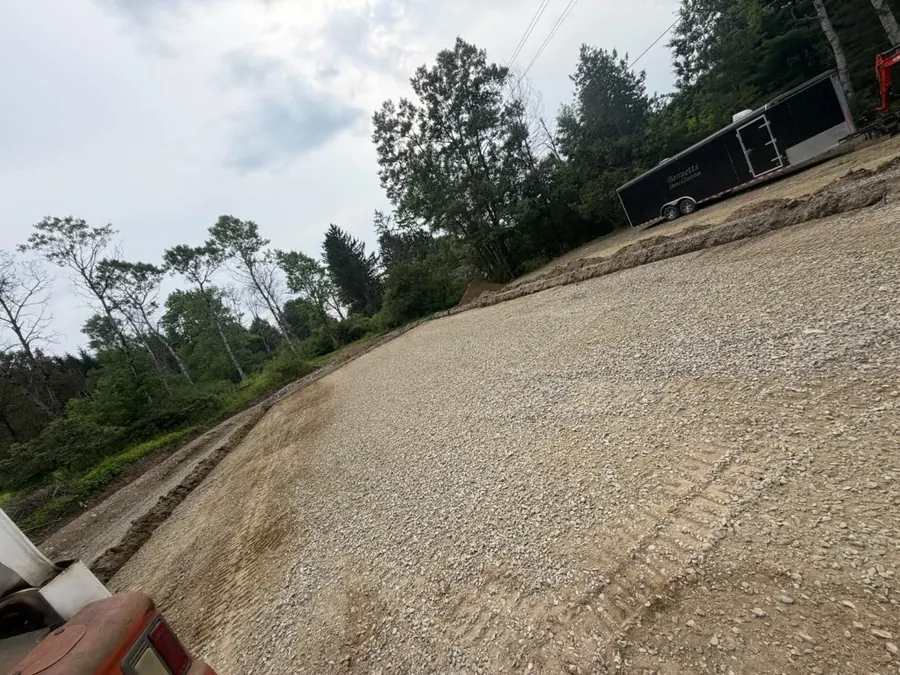
By Bennett's Concrete and Excavation, Norwich, NY. Updated October 2026.
The short answer
Stone is sold by the ton, but you spread it by area and depth, so you need a conversion. A cubic yard of gravel weighs roughly 1.3 to 1.5 tons. One gravel company, Gorham Sand & Gravel, lists sand at about 1.3 tons per cubic yard, DOT gravel at about 1.4 and stone at about 1.5. A FEMA appeal decision settled on 1.4 tons per cubic yard for loose aggregate spread by grading or tailgate delivery.
Using 1.4, one ton is about 19 cubic feet. Spread 4 inches deep, that covers about 58 square feet.
Coverage chart for one ton
| Depth | 1.3 tons/yd | 1.4 tons/yd | 1.5 tons/yd |
|---|---|---|---|
| 2 inches | 125 sq ft | 116 sq ft | 108 sq ft |
| 3 inches | 83 sq ft | 77 sq ft | 72 sq ft |
| 4 inches | 62 sq ft | 58 sq ft | 54 sq ft |
| 6 inches | 42 sq ft | 39 sq ft | 36 sq ft |
These are loose, uncompacted numbers, rounded. Our gravel calculator uses the same 1.3, 1.4 and 1.5 tons per yard range.
The math, step by step
- Multiply length by width in feet to get square feet.
- Multiply by depth in feet. Four inches is 4 divided by 12, or about 0.33 feet.
- Divide cubic feet by 27 to get cubic yards.
- Multiply cubic yards by tons per yard for your material.
Example: a driveway 100 feet long and 12 feet wide, 4 inches deep. That's 1,200 square feet times 0.33 feet, or 400 cubic feet. Divided by 27, it's about 14.8 cubic yards. At 1.4 tons per yard, that's about 21 tons. At 1.3 it's about 19, and at 1.5 about 22.
Why compacted stone takes more
Compacting pushes stone particles closer together, so a compacted layer weighs more per yard than a loose one. In the FEMA decision, a quarry manager estimated a conversion for compacted gravel could be 1.89 tons per cubic yard or higher, compared with 1.4 for loose.
In practice, if you need 4 inches of compacted base, order enough to spread more than 4 inches loose. That's why contractors add a margin, and why a new driveway base takes more stone than the simple math suggests.
What changes the weight
- Material. Sand and lighter stone are on the low end, crusher run with fines on the high end.
- Moisture. Wet stone weighs more than dry stone.
- Size mix. Stone with fines fills its own gaps and weighs more per yard than clean, single-size stone.
- The quarry. Rock type varies. Ask your supplier for their number.
Common jobs, worked out
These use 1.4 tons per cubic yard, loose, rounded. Heavier stone will need a bit more.
| Job | Size and depth | About |
|---|---|---|
| Shed pad | 10 x 10 ft, 4 in. | 1.7 tons |
| Garden path | 50 x 3 ft, 3 in. | 1.9 tons |
| Parking pad | 20 x 20 ft, 4 in. | 6.9 tons |
| Top dressing a driveway | 100 x 12 ft, 2 in. | 10.4 tons |
| Long driveway top layer | 300 x 12 ft, 4 in. | 62 tons |
A shed pad also needs the ground leveled and a frame or edge to hold the stone. See shed pad options.
Tons or yards?
Some yards sell by the ton and some by the yard. If your supplier sells by the yard, stop at step 3 of the math. If they sell by the ton, ask what weight per yard they use for that product, because it's the number that turns your measurements into an order. If the numbers don't match what you expected, ask before the truck is loaded, not after.
Base and top are separate orders
A new driveway usually has a base layer of larger stone and a top layer of finer stone. Run the numbers once for each. Our crushed stone sizes guide explains which stone goes where.
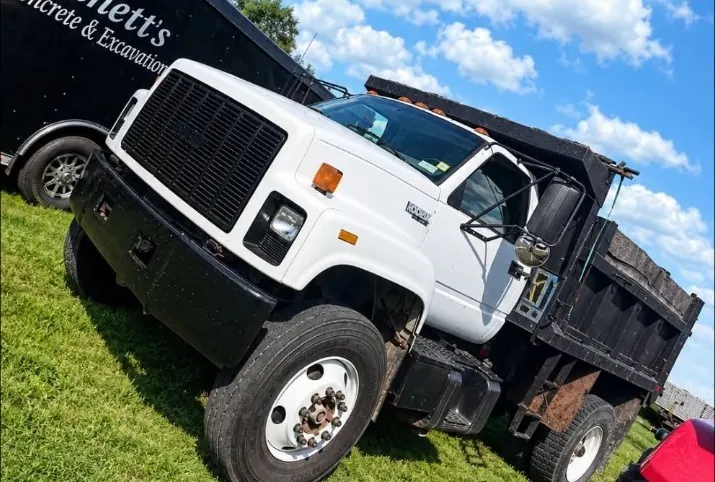
We haul stone with our own dump truck. Send us your measurements and we'll confirm the tons before it's loaded. See gravel delivery.