By Bennett's Concrete and Excavation, Norwich, NY. Updated October 2026.
Why aprons fail first
- Salt. Even if you never salt your own driveway, salt and slush drip off your car onto the apron all winter.
- Water. Garage floors are sloped to move liquids toward a drain or out the door, so the apron is where melt water lands.
- Plows. The apron is where the plow turns and scrapes.
- Settled fill. Soil dug out for the foundation and backfilled against it can keep settling for years, and the apron often sits right on top of it.
- Tires. Every vehicle that enters the garage crosses it, turning and braking.
Signs it's time
- The apron has dropped and water runs back toward the garage door.
- The apron has lifted and the door catches on it or won't seal.
- The surface is scaling or pitted from salt.
- Cracks have opened and panels have broken into pieces.
- There's a trip lip where the apron meets the garage floor or the driveway.
Repair or replace?
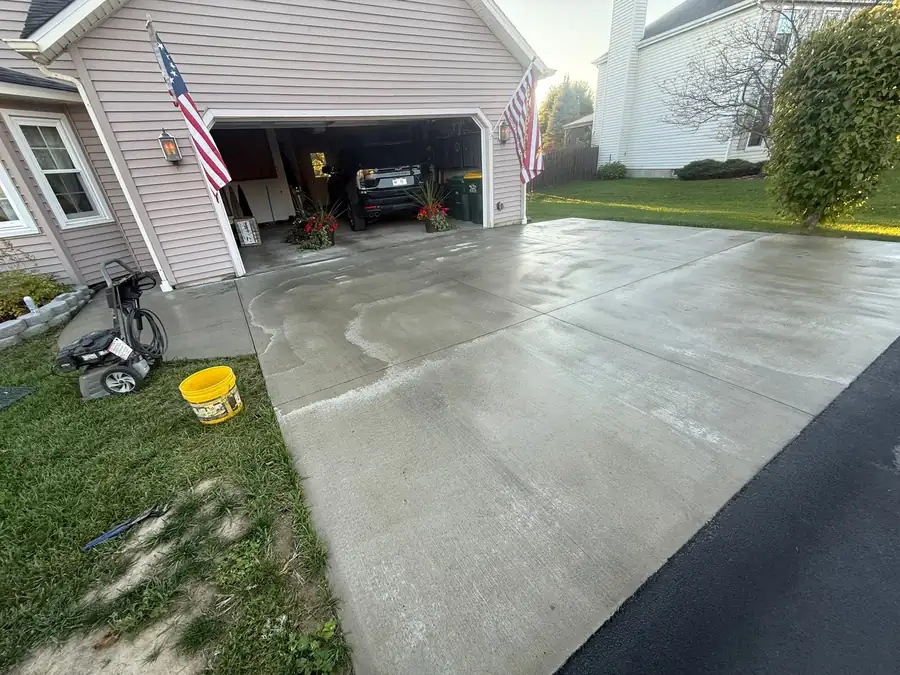
Light surface wear can be cleaned and sealed. An apron that has dropped, heaved or broken up needs to come out. Because the apron is usually its own panel, separated by joints from the garage floor and the driveway, it can often be replaced without touching the rest. See repair or replace a driveway for the bigger picture.
How a replacement apron is built
- Saw cut cleanly at the joint lines and break out the old apron.
- Dig out soft or settled fill and replace it with compacted crushed stone.
- Set grades so the apron slopes away from the door. The residential code (R309.1) requires the garage floor's parking area to slope toward a drain or the main vehicle door, so the apron has to keep that water moving away.
- Install isolation joint material where the new apron meets the garage slab and other walks. NRMCA calls for isolation joints where driveways meet walks, curbs and other structures.
- Set reinforcement and pour exterior-grade concrete. NRMCA recommends a specified strength of 4,000 psi and about 6 percent air for slabs that freeze and get deicers.
- Broom finish, cut joints and cure.
Salt and sealing
The new apron's first winter is the hardest. NRMCA advises no deicers on new concrete in its first winter, and never ammonium sulfate, ammonium nitrate or magnesium-based salts. Use sand for traction, and rinse off salty slush on mild days.
Sealing helps keep salt water out of the surface. Bennett's uses a salt-repellent sealer on aprons, and offers washing, degreasing and resealing for older ones. Read first winter care before your apron sees its first snow.
Apron with a gravel driveway
Plenty of rural homes have a long gravel driveway and a concrete apron at the garage. It's a practical pairing: the apron keeps stone out of the garage and gives a clean, hard surface where cars turn and park. A short transition where the gravel meets the concrete keeps the edge from breaking down. See gravel vs. concrete driveways and our gravel driveway work.
What to expect on apron day
An apron replacement is a small job with a big effect on daily life, because the garage door is out of use until the new concrete is ready.
- Plan where cars will park, and move anything you'll need out of the garage first.
- Expect saw cutting noise and dust for part of a day.
- The door's bottom seal should close onto the new concrete without a gap; that's checked when grades are set.
- Where the apron meets a gravel or asphalt drive, the transition is shaped so tires roll on without a bump.
- Keep kids, pets and the mail carrier off the fresh concrete. Footprints set fast.
Ask your contractor when the door can be used for foot traffic and when it can carry a car. Those are usually two different days.
Next steps
Note when water runs the wrong way and whether the door seals. Those details help size the fix. Bennett's handles concrete removal and replacement, new aprons and sealing.