By Bennett's Concrete and Excavation, Norwich, NY. Updated October 2026.
The short answer
Common residential guidance, such as ConcreteNetwork's, is to wait about 7 days before driving a passenger car on a new driveway and at least 28 days before heavy vehicles like RVs, loaded pickups with trailers or delivery trucks.
Highway agencies use the same idea with test data behind it. The National Concrete Pavement Technology Center reports that state DOTs commonly open new concrete pavement after about 7 days, or sooner once it reaches a set strength, usually somewhere between 2,000 and 3,000 psi in compression.
A practical timeline
| Load | Typical wait |
|---|---|
| Foot traffic | At least 24 hours |
| Bikes, scooters, kids' toys | About 3 days |
| Passenger cars and light trucks | About 7 days |
| RVs, loaded trucks, heavy equipment | About 28 days |
These assume normal warm-weather curing. Your contractor may adjust them for the mix, the weather and the slab thickness.
It's really about strength, not the calendar
The days are a stand-in for strength. Quikrete's published data for its standard bagged concrete mix shows about 2,500 psi at 7 days and about 4,000 psi at 28 days, so at one week the concrete has well over half its rated strength but not all of it.
That's why highway crews test cylinders or use the maturity method before they open early, and why we'd rather you wait a few extra days than crack a new slab to save a week.
Thickness plays in too. A thicker driveway built for heavier vehicles spreads the load better, but it follows the same strength curve. Our slab thickness guide covers how thickness is chosen.
Cold weather adds time
Strength gain slows as temperatures drop. NRMCA notes that cold weather produces a slower rate of in-place strength gain, and its cold-weather guide says new concrete must be kept from freezing until it reaches about 500 psi. A driveway poured in late October in Chenango County will not be where a July driveway is at day 7.
If your pour falls in the shoulder season, ask how long to wait rather than counting on the one-week rule. See our cold weather concrete guide.
Heavy trucks are the real risk
A loaded ready-mix truck weighs about 80,000 pounds, according to NRMCA. Dump trucks, propane and oil deliveries, well drillers and moving trucks are all heavy enough to crack a young driveway. Before the pour:
- Schedule fuel deliveries before the pour or after the 28-day mark.
- Tell anyone doing work at the house to park on the road.
- Put a cone or a sawhorse at the end of the driveway for the first week.
- Plan where you'll park in the meantime, especially with a single-lane rural driveway.
Other first-month rules
- Don't turn the steering wheel hard while parked on new concrete. Scuffing a soft surface leaves marks.
- Keep tracked equipment, skid steers and trailer jacks off it until it has reached its full strength. A jack stand puts a lot of weight on a very small spot.
- Keep it clean of spilled oil and fuel. Fresh concrete soaks things up. See removing oil stains from concrete.
- Skip deicers the first winter. Our first winter care guide explains why.
- Seal it once it has cured. See the sealing guide.
Signs it was loaded too soon
Cracking from early loads usually shows up where tires track, at panel corners and near the edges where the slab has the least support. A tire scuff or mark in the surface is another clue that it was still soft. If you see a new crack in the first weeks, take a dated photo and call your contractor so they can look at it while the cause is fresh.
Not every crack means the slab was loaded early. Shrinkage cracks can show up on their own, and our guide to hairline cracks in new concrete explains how to tell them apart.
Planning a new driveway or apron
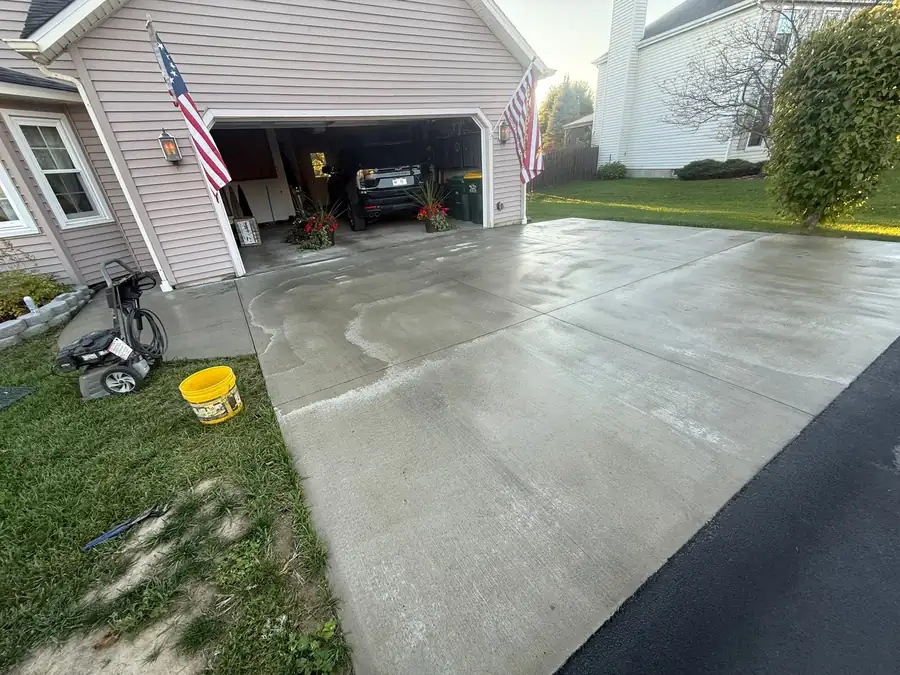
If you're replacing a concrete driveway or just the apron at the garage, ask your contractor to sequence the work so you still have a way in and out during the wait. On many jobs that means pouring in sections or leaving a gravel lane open. Our garage apron guide covers that kind of phasing.
Sources
- ConcreteNetwork.com: How long to wait before driving on new concrete
- National Concrete Pavement Technology Center: Early Opening of concrete pavements
- Quikrete: Concrete Mix No. 1101 data sheet
- NRMCA, CIP 10: Strength of In-Place Concrete
- NRMCA, CIP 31: Ordering Ready Mixed Concrete
- NRMCA, CIP 27: Cold Weather Concreting