By Bennett's Concrete and Excavation, Norwich, NY. Updated October 2026.
The short answer
Air-entrained concrete contains tiny, evenly spaced air bubbles made by an admixture at the plant. When water in the concrete freezes and expands, those bubbles give it room. Without them, the pressure breaks off the surface, a problem called scaling.
For outdoor concrete in New York, it's a code item. A Town of Amherst building department memo summarizing the Residential Code of New York says concrete exposed to the weather must be air entrained, with total air content not less than 5 percent or more than 7 percent.
How much air
Different sources describe the same target in slightly different ways:
- The Portland Cement Association says entrained air is usually between 4 and 7 percent of the concrete's volume, in the form of billions of microscopic air cells per cubic foot.
- NRMCA's guide on scaling recommends 6 percent total air for concrete with 3/4-inch or 1-inch coarse aggregate.
- NRMCA's ordering guide says delivered air content has a tolerance of plus or minus 1.5 percent.
Your supplier sets the dose for the mix. Your job is to make sure the order says the concrete is going outside, so it gets air.
Exposure classes
Engineers and suppliers sort concrete by how much freeze-thaw it will see. NRMCA's durability guide lists these classes, and the stricter ones also need a lower water-cement ratio and higher strength.
| Class | Exposure | Max w/cm | Min strength |
|---|---|---|---|
| F0 | Not exposed to freezing | none | 2,500 psi |
| F1 | Freezing, limited water | 0.55 | 3,500 psi |
| F2 | Freezing, frequently wet | 0.45 | 4,500 psi |
| F3 | F2 plus deicing chemicals | 0.45 plain, 0.40 reinforced | 4,500 psi plain, 5,000 psi reinforced |
A Central NY driveway, apron, sidewalk or step that sees road salt from your car sits at the wet, salted end of that table.
Air and strength
Air bubbles take up space, so they lower strength a little. NRMCA notes that a 1 percent change in air content can change compressive strength by 5 percent or more. Mixes are designed with that in mind, which is why you can't just add more air at the truck and call it better.
Finishing air-entrained concrete
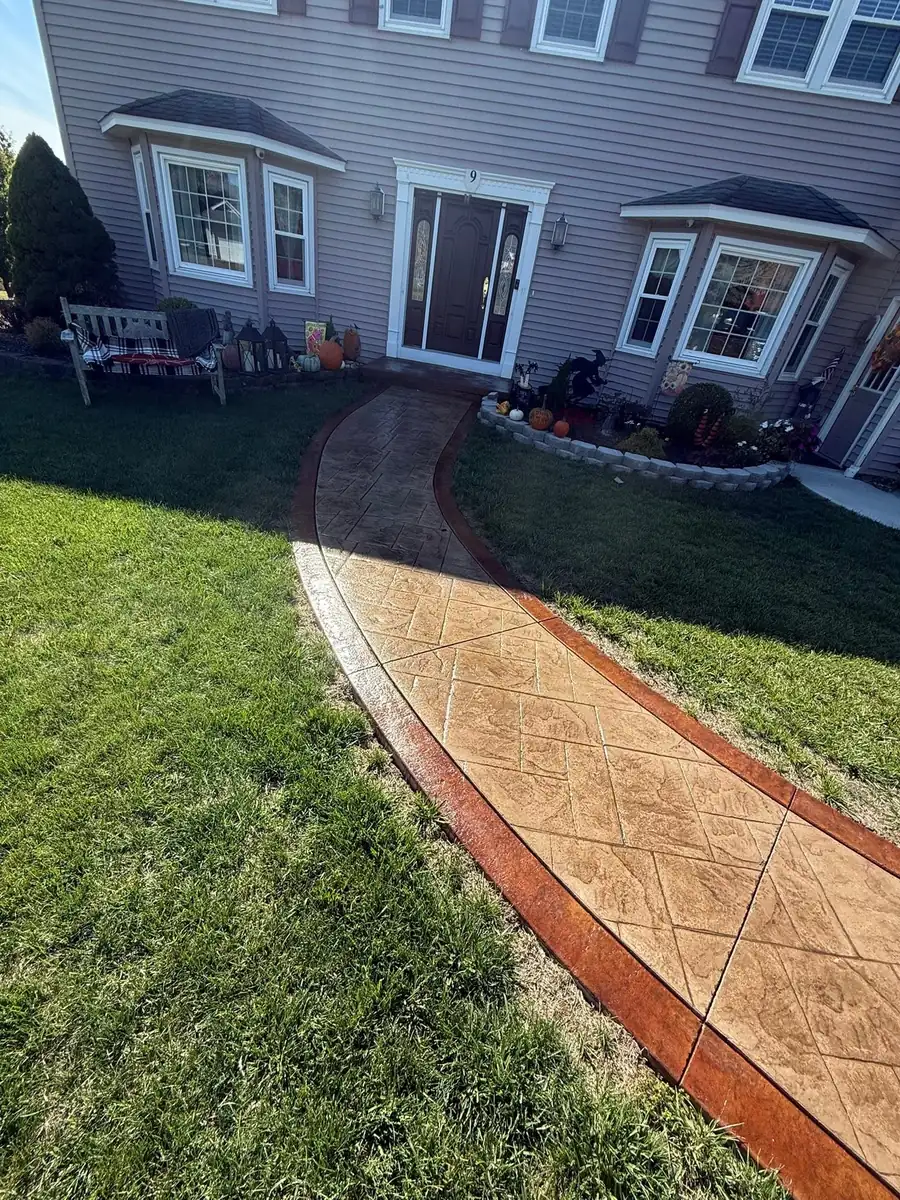
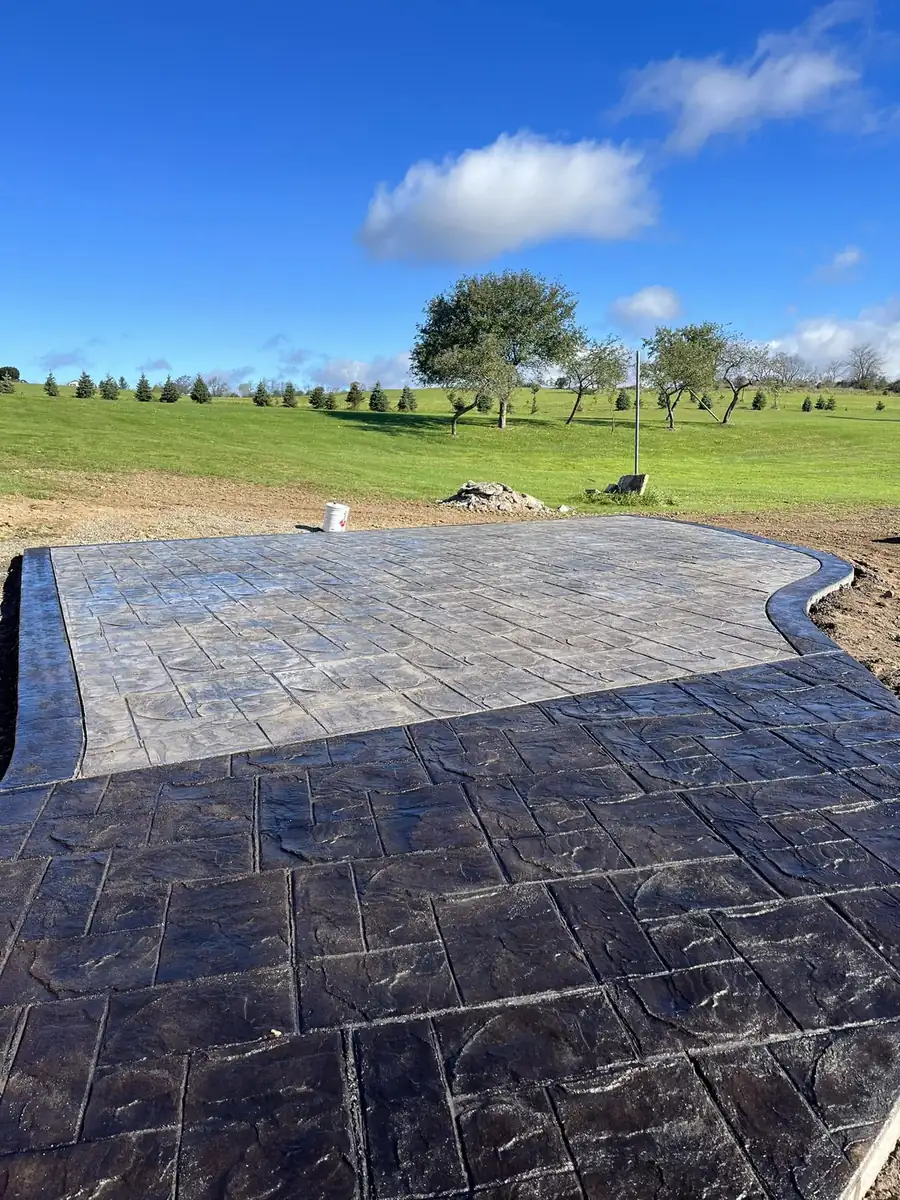
NRMCA's finishing guide says to avoid steel troweling air-entrained concrete. It bleeds more slowly, and sealing the surface too early can trap water and cause blisters or delamination. For exterior slabs, a floated and broomed finish is the norm, and NRMCA's scaling guide says a broom finish is usually adequate outdoors. Stamped concrete is finished with its own tools and sequence. See broom finish vs smooth trowel.
That's one reason an indoor garage floor that gets a hard power-troweled finish and an outdoor patio may be ordered as different mixes. The plans and supplier decide.
Pumping can knock air out
When concrete drops down a steep vertical boom, some air can be lost. NRMCA reports samples at the end of a vertical boom can show less than half the air measured at the truck chute. A flatter boom setup and a steady flow help. More in our pump truck guide.
How you know you got it
On bigger jobs, air content is tested on site from the truck with an air meter, and the result has to land within the tolerance on the order. On a small residential pour there may be no test, so the order is what protects you. The delivery ticket lists the mix. Ask your contractor which mix was ordered for outdoor work, and keep the ticket with your house records.
If outdoor concrete starts flaking in its first few winters, missing or low air is one of the first things NRMCA lists as a cause.
Air is not a license to salt
Air entrainment is the biggest single defense against scaling, but NRMCA still recommends no deicers on new concrete the first winter and moderate use after that. Never use ammonium sulfate or ammonium nitrate. See new concrete winter care and scaling and spalling. When we order concrete for driveways, walks and steps, we order it for outdoor exposure.
Sources
- Town of Amherst NY Building Dept: Residential Code concrete requirements memo
- Portland Cement Association: Working with Concrete
- NRMCA, CIP 2: Scaling Concrete Surfaces
- NRMCA, CIP 31: Ordering Ready Mixed Concrete
- NRMCA, CIP 44: Durability Requirements for Concrete
- NRMCA, CIP 21: Loss of Air Content in Pumped Concrete
- NRMCA, CIP 14: Finishing Concrete Flatwork