By Bennett's Concrete and Excavation, Norwich, NY. Updated October 2026.
The short answer
Use bags for small jobs: fence and mailbox posts, a step repair, a small landing or pad. For patios, walks, driveways, garage floors and anything bigger, order ready-mix. The math explains why. Quikrete's data sheet lists an 80-pound bag of concrete mix at about 0.6 cubic feet. A cubic yard is 27 cubic feet, so one yard takes 45 bags, roughly 3,600 pounds of material to lift, open and mix.
Side by side
| Bagged mix | Ready-mix | |
|---|---|---|
| Best for | Under a yard, hard-to-reach spots, posts | Anything from about a yard up |
| Strength | Quikrete No. 1101: about 4,000 psi at 28 days | Ordered to the job; 3,500 to 5,000 psi is typical (NRMCA) |
| Air entrainment | Depends on the product | Specified on the order for outdoor work |
| Consistency | Varies batch to batch with water | Batched by weight at the plant |
| Labor | Heavy: every bag is lifted and mixed | Truck delivers mixed concrete |
| Access | Anywhere a wheelbarrow goes | Truck access or a pump |
Where bags go wrong
- Water. Quikrete lists about 6 to 9 pints of water for an 80-pound bag. It's easy to add more to make it easier to work, and NRMCA notes that extra water lowers strength and durability and raises cracking.
- Batches that don't match. On a slab, the first batches start setting while the last ones are still being mixed. That leaves weak lines and uneven color.
- Not enough hands. Finishing has to happen while the concrete is workable. One person mixing bags can't keep up with a slab.
- Too thin. Quikrete's mix is designed for pours 2 inches thick or more. Thin patches over old concrete need a different product.
What ready-mix gives you
Ready-mix is batched at the plant to an order. NRMCA's ordering guide lists what goes on that order: strength, slump, air content where it freezes, maximum stone size, volume, and the delivery details. That's how outdoor concrete in Central NY gets the entrained air and strength it needs. See air-entrained concrete and concrete strength and psi.
Ready-mix needs access
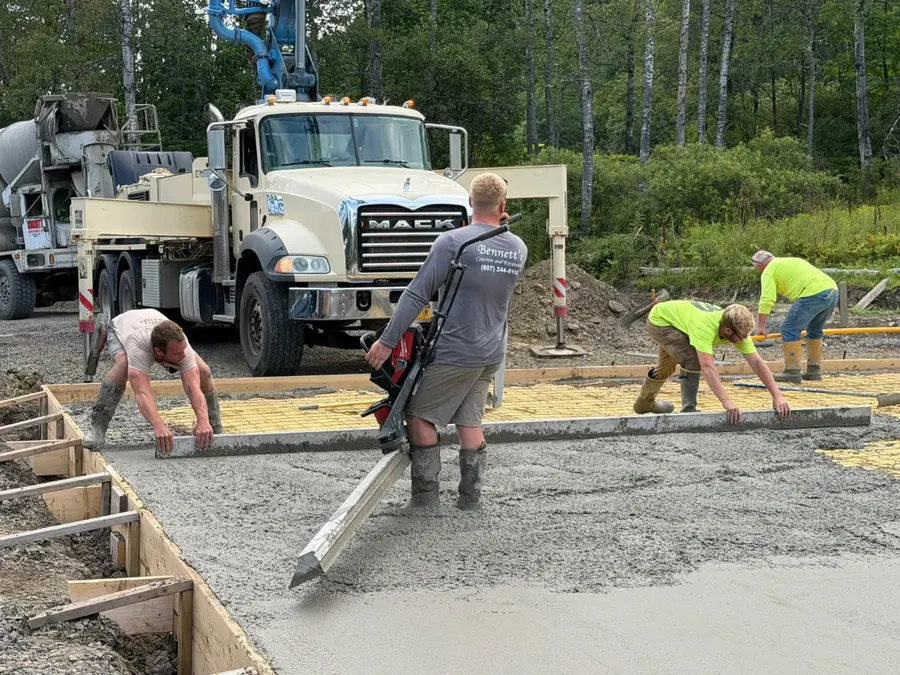
NRMCA says a truck mixer holds 8 to 12 cubic yards and a loaded truck weighs about 80,000 pounds. NRMCA also warns that loose dirt and residential curbs or walkways may not hold one. A backyard patio behind the house, a basement or a spot past the septic field may need a pump truck or a buggy instead of the truck chute.
Small loads
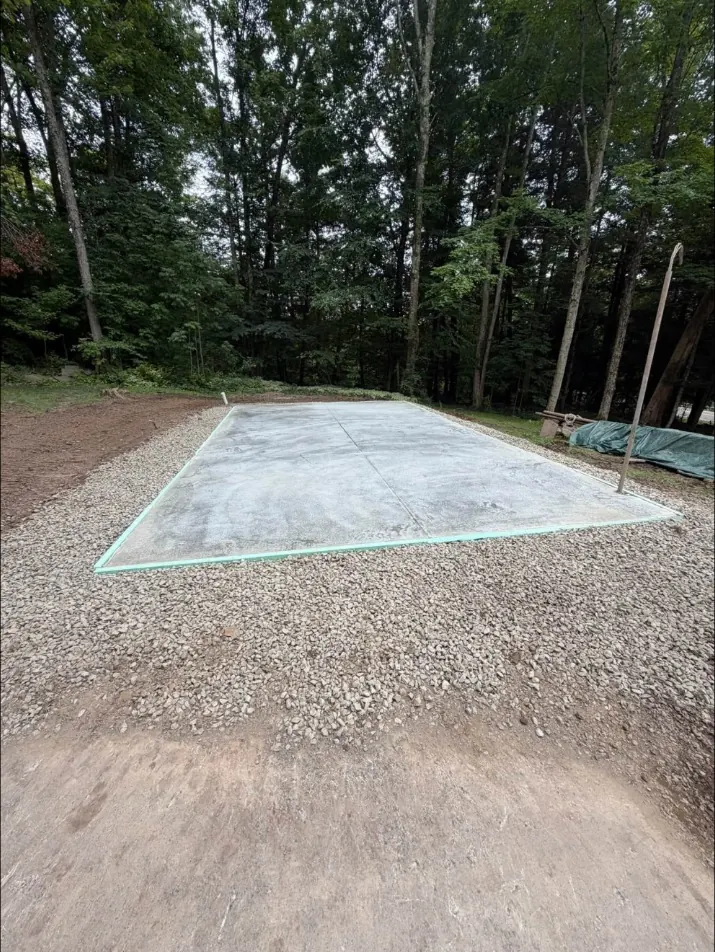
Ready-mix plants can deliver less than a full truck. Ask the plant about its minimum order and any small-load charge, and note that NRMCA advises against small cleanup loads. If your job is somewhere between a few bags and a full truck, ask the plant or your contractor what makes sense. Sometimes combining two small projects, like a shed pad and a walk, into one pour is the better plan. See shed pads, gravel vs concrete.
Figuring how much you need
Use our concrete calculator for the yardage, or see how much a yard of concrete covers. If the answer is more than a dozen or so bags, it's worth pricing ready-mix.
If you do use bags
Quikrete's directions for its standard concrete mix are a good checklist for any bagged job:
- Use the water amount on the bag, about 6 to 9 pints for 80 pounds, and no more than you need.
- Start curing as soon as possible and keep it up for 5 days in warm weather (70 degrees F and up) or 7 days when it's 50 to 70 degrees F.
- Protect it from freezing for the first 48 hours.
- Don't apply a curing compound if rain or temperatures below 50 degrees F are expected within 24 hours.
Small jobs fail for the same reasons big ones do: too much water and not enough curing. See how long concrete takes to cure.
What we use
On our slabs, patios, walks and floors, concrete comes from ready-mix trucks, with a pump truck on the bigger pours. Bagged mix has its place on small repairs and post holes. If you're planning a slab or pad and aren't sure which way to go, we can look at the size and access with you.